Appearance
LayerNorm、BatchNorm1d、Dropout:Transformer 层里的稳定化函数
Abstract
这篇只讲三类稳定化函数:
LayerNorm让每个 token 的 hidden 维稳定,BatchNorm1d让卷积通道稳定,Dropout在训练时随机置零防止过拟合。
0. 文件索引
| 项目 | 内容 |
|---|---|
| 覆盖函数 | nn.LayerNorm / nn.BatchNorm1d / nn.Dropout |
| 主要源码 | Transformer_EncDec.py |
| 覆盖模型 | Informer / PatchTST |
| 核心区别 | LayerNorm 看最后一维;BatchNorm1d 看 channel 维;Dropout 不改 shape |
1. Level 1:三者在源码里的位置
Transformer EncoderLayer:
python
class EncoderLayer(nn.Module):
    def __init__(self, attention, d_model, d_ff=None, dropout=0.1, activation="relu"):
        super(EncoderLayer, self).__init__()
        d_ff = d_ff or 4 * d_model
        self.attention = attention
        self.conv1 = nn.Conv1d(in_channels=d_model, out_channels=d_ff, kernel_size=1)
        self.conv2 = nn.Conv1d(in_channels=d_ff, out_channels=d_model, kernel_size=1)
        self.norm1 = nn.LayerNorm(d_model)
        self.norm2 = nn.LayerNorm(d_model)
        self.dropout = nn.Dropout(dropout)
        self.activation = F.relu if activation == "relu" else F.gelu

    def forward(self, x, attn_mask=None, tau=None, delta=None):
        new_x, attn = self.attention(x, x, x, attn_mask=attn_mask, tau=tau, delta=delta)
        x = x + self.dropout(new_x)

        y = x = self.norm1(x)
        y = self.dropout(self.activation(self.conv1(y.transpose(-1, 1))))
        y = self.dropout(self.conv2(y).transpose(-1, 1))

        return self.norm2(x + y), attn
Informer ConvLayer:
python
class ConvLayer(nn.Module):
    def __init__(self, c_in):
        super(ConvLayer, self).__init__()
        self.downConv = nn.Conv1d(...)
        self.norm = nn.BatchNorm1d(c_in)
        self.activation = nn.ELU()
        self.maxPool = nn.MaxPool1d(kernel_size=3, stride=2, padding=1)
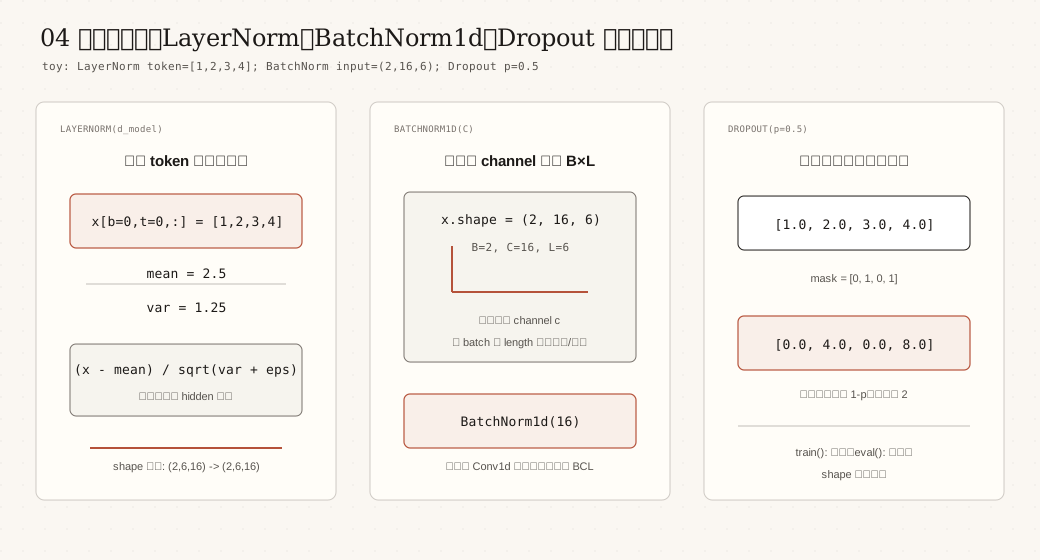
对 PatchTST 来说,LayerNorm 和 Dropout 主要出现在 EncoderLayer 里面;BatchNorm1d 则更常见于 Informer 的 ConvLayer。下图不画完整网络,而是按本文三个 toy 例子对比它们到底在哪些维度上工作。
2. Level 2:LayerNorm(d_model)
LayerNorm 在这些模型里通常处理:
text
x.shape = (B, L, d_model)源码:
python
self.norm1 = nn.LayerNorm(d_model)
self.norm2 = nn.LayerNorm(d_model)
含义:
对每个样本、每个时间位置的
d_model维向量单独归一化。
toy:
text
x.shape = (2, 6, 16)
LayerNorm(16)
输出 shape = (2, 6, 16)
它不改变 shape。
它改变的是每个 token 内部 hidden 维的均值和方差。
3. Level 3:LayerNorm 的可算小例子
只看一个 token:
text
x[b=0, t=0, :] = [1, 2, 3, 4]均值:
text
mean = (1 + 2 + 3 + 4) / 4 = 2.5方差:
text
var = ((1-2.5)^2 + (2-2.5)^2 + (3-2.5)^2 + (4-2.5)^2) / 4
    = 1.25
标准化:
text
(x - mean) / sqrt(var + eps)所以 LayerNorm 的直觉是:
每个 token 自己内部做一次标准化。
4. Level 4:BatchNorm1d(c_in)
Informer 的 ConvLayer 里:
python
self.norm = nn.BatchNorm1d(c_in)此时输入格式已经是 Conv1d 格式:
text
x.shape = (B, C, L)toy:
text
x.shape = (2, 16, 6)
BatchNorm1d(16)
输出 shape = (2, 16, 6)
BatchNorm1d(16) 的 16 对应 channel 数。
它会按 channel 统计 batch 和 length 上的均值方差。
直觉:
对每个 channel,把整个 batch 和时间轴上的分布稳定住。
5. Level 5:LayerNorm 和 BatchNorm1d 的区别
| 函数 | 典型输入 | 归一化主要看哪一维 | 常见位置 |
|---|---|---|---|
LayerNorm(d_model) | (B, L, d_model) | 最后一维 hidden | Transformer 残差后 |
BatchNorm1d(C) | (B, C, L) | channel 维,对 batch/length 统计 | Conv1d 后 |
最实用的判断:
text
如果张量是 (B,L,d_model),优先想到 LayerNorm。
如果张量是 (B,C,L),并且刚过 Conv1d,可能是 BatchNorm1d。
6. Level 6:Dropout(p)
源码:
python
self.dropout = nn.Dropout(dropout)在 forward 里:
python
x = x + self.dropout(new_x)
y = self.dropout(self.activation(...))
y = self.dropout(...)
Dropout 的作用:
训练时以概率
p把部分元素置 0,并按比例缩放剩余元素;推理时不随机置零。
它不改变 shape。
toy:
text
x.shape = (2, 6, 16)
dropout(x).shape = (2, 6, 16)
如果 p=0.5,训练时某些元素会被置 0:
text
[1.0, 2.0, 3.0, 4.0]
可能变成
[0.0, 4.0, 0.0, 8.0]
这里的 4.0 和 8.0 是因为 PyTorch 训练时会对保留下来的元素做缩放,保持期望不变。
7. 常见错误
7.1 以为 LayerNorm 会跨 batch 归一化
不会。
LayerNorm(d_model) 对每个 token 自己的最后一维做归一化。
7.2 把 BatchNorm1d 用在 (B,L,C) 上
BatchNorm1d(C) 常见输入是:
text
(B, C, L)如果你拿 (B,L,C) 直接喂进去,它会把 L 当成 channel。
7.3 忘记 Dropout 的训练/推理差异
Dropout 在:
python
model.train()和:
python
model.eval()行为不同。
训练时随机置零,推理时不随机置零。
8. 一句话总结
这三个函数的速记:
text
LayerNorm: 每个 token 的最后一维归一化
BatchNorm1d: Conv1d 的 channel 维归一化
Dropout: 训练时随机置零,不改 shape