Appearance
Layer 4 — AutoCorrelationLayer 精读
由 EncoderLayer([[03B1-Layer3-EncoderLayer]])和 DecoderLayer([[03C1-Layer3-DecoderLayer]])调用,共计 4 种场景。
本层是 d_model ↔ 多头格式的桥梁,内部注意力计算委托给AutoCorrelation。
1. 在父层中的位置
| 调用位置 | mask_flag | Q 来源 | K/V 来源 | L_Q | L_K |
|---|---|---|---|---|---|
| EncoderLayer[0,1] 自注意力 | False | enc_out (2,12,8) | enc_out (2,12,8) | 12 | 12 |
| DecoderLayer masked 自注意力 | True | dec_out (2,10,8) | dec_out (2,10,8) | 10 | 10 |
| DecoderLayer cross 注意力 | False | dec_out (2,10,8) | enc_out (2,12,8) | 10 | 12 |
2. I/O 接口定义
以 EncoderLayer 自注意力(toy)为例:
| shape | 含义 | |
|---|---|---|
输入 queries | (2, 12, 8) | encoder token(自注意力时 Q=K=V) |
输入 keys | (2, 12, 8) | 同上 |
输入 values | (2, 12, 8) | 同上 |
输出 out | (2, 12, 8) | 注意力聚合后投影回 d_model |
输出 attn | None | output_attention=False 时为 None |
3. 顺序图(具体层)
4. 语义分组图(索引层)
结构与 Informer 的 AttentionLayer 完全相同,唯一区别:内部注意力换成 AutoCorrelation(FFT 互相关)而非 ProbAttention(稀疏查询筛选)。
5. 逐步精读
5.0 完整原始代码
python
class AutoCorrelationLayer(nn.Module):
    def __init__(self, correlation, d_model, n_heads, d_keys=None, d_values=None):
        super(AutoCorrelationLayer, self).__init__()

        d_keys = d_keys or (d_model // n_heads)
        d_values = d_values or (d_model // n_heads)

        self.inner_correlation = correlation
        self.query_projection = nn.Linear(d_model, d_keys * n_heads)
        self.key_projection = nn.Linear(d_model, d_keys * n_heads)
        self.value_projection = nn.Linear(d_model, d_values * n_heads)
        self.out_projection = nn.Linear(d_values * n_heads, d_model)
        self.n_heads = n_heads

    def forward(self, queries, keys, values, attn_mask):
        B, L, _ = queries.shape
        _, S, _ = keys.shape
        H = self.n_heads

        queries = self.query_projection(queries).view(B, L, H, -1)
        keys = self.key_projection(keys).view(B, S, H, -1)
        values = self.value_projection(values).view(B, S, H, -1)

        out, attn = self.inner_correlation(queries, keys, values, attn_mask)
        out = out.view(B, L, -1)

        return self.out_projection(out), attn
5.1 格式转换 IN:d_model → 多头
python
B, L, _ = queries.shape
_, S, _ = keys.shape
H = self.n_heads

queries = self.query_projection(queries).view(B, L, H, -1)
keys    = self.key_projection(keys).view(B, S, H, -1)
values  = self.value_projection(values).view(B, S, H, -1)
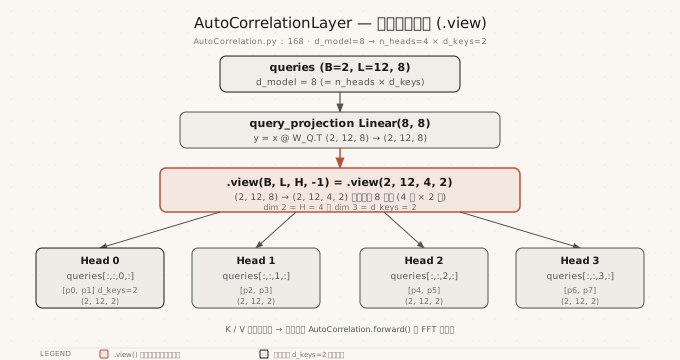
d_keys = d_model // n_heads = 8 // 4 = 2。
query_projection = nn.Linear(8, 8):(2,12,8)。.view(2, 12, 4, -1) 把最后一维 8 拆成 (H=4, d_keys=2) → (2, 12, 4, 2)。
queries[0, 0, :] = [p0,p1,p2,p3,p4,p5,p6,p7]
              ↓ .view(4, 2)
Head 0: [p0, p1]
Head 1: [p2, p3]
Head 2: [p4, p5]
Head 3: [p6, p7]
L 和 S 分开取:cross-attention 时 L=10 (decoder) ≠ S=12 (encoder),若共用会导致 .view() 报错。
| 操作 | 代码 | 说明 |
|---|---|---|
| Linear Q 投影 | query_projection(queries) | |
| 多头拆分 | .view(B, L, H, -1) | 最后一维 |
| K/V 同步拆分 | .view(B, S, H, -1) | 形式相同,S 可与 L 不同(cross-attn) |
| 格式确认 | (B,L,H,D) | AutoCorrelation 期望此格式,内部再 permute 为 (B,H,E,L) |
5.2 注意力计算(委托 AutoCorrelation,步骤三)
python
out, attn = self.inner_correlation(queries, keys, values, attn_mask)传入 queries=(2,12,4,2),keys=(2,12,4,2),values=(2,12,4,2)(自注意力时)。
AutoCorrelation 接收 (B, L, H, E) 格式,内部 permute 为 (B,H,E,L) 后做 FFT 互相关,返回 out (2,12,4,2) = (B,L,H,D)。
→ 详见 [[04A-Layer5-AutoCorrelation]]
5.3 格式转换 OUT:多头 → d_model
python
out = out.view(B, L, -1)
return self.out_projection(out), attn
AutoCorrelation 返回的 out 格式为 (B, L, H, D) = (2, 12, 4, 2)。.view(2, 12, -1) 合并最后两维 → (2, 12, 8)。out_projection = Linear(8, 8) 做最终线性混合 → (2, 12, 8)。
与 Informer AttentionLayer 的格式差异
Informer 的 ProbAttention 返回
(B, H, L_Q, D)格式,需要 transpose 后才能.view()。
AutoCorrelation 直接返回(B, L, H, D)格式,可直接.view(B, L, -1)— 两者格式不同,但 AutoCorrelationLayer 和 AttentionLayer 各自的.view()调用都是正确的。
6. 下钻子组件
| 子组件 | 职责 | 下层文档 |
|---|---|---|
AutoCorrelation | FFT 周期检测 + top-k lag 时延聚合 | [[04A-Layer5-AutoCorrelation]] |