Appearance
FEDformer 总览
一、论文问题与动机
Autoformer 的残留问题:Autoformer 用 FFT 计算时延相关(Auto-Correlation),找到 top-k 个 lag 并做时延聚合。这是对注意力的改进,但:
- 仍是局部的:top-k lag 选择是基于平均相关强度,忽略了频谱中每个频率各自的贡献
- 没有利用频谱全局结构:模型只知道"哪几个 lag 最重要",不知道"频谱的低秩结构"
FEDformer 的核心论点:
时间序列的有用信息在频谱中高度稀疏——只有
个傅里叶模式携带绝大多数能量。因此直接在 个频率上做注意力,复杂度为 ,在 固定时等价于 严格线性。
Informer  → "O(L²) 太慢"               → ProbSparse → O(L log L)
Autoformer → "忽略时序周期性"           → Auto-Correlation(FFT 自相关)+ 分解
FEDformer → "Auto-Correlation 仍是局部的" → 完整频域注意力:直接操作 M 个频率 → O(L)
二、核心创新
2.1 FourierBlock(频域 Self-Attention)
标准 Self-Attention 在时域做
Q (B, L, H, E)
  → permute → (B, H, E, L)
  → rfft    → (B, H, E, L//2+1)  [复数频谱]
  → 选 M 个频率 index = [ω₁, ..., ωM](random 或 low)
  → for each ωᵢ: out_ft[:,:,:,wi] = compl_mul1d(Q_freq[:,:,:,i], W[:,:,:,wi])
     ← 每个频率独立地做复数线性变换,W ∈ ℂ^{H×E×E}
  → irfft(out_ft, n=L) → (B, H, E, L)
公式:
2.2 FourierCrossAttention(频域 Cross-Attention)
Decoder cross-attention 中 Q 来自 decoder(dec_len=10),K/V 来自 encoder(seq_len=12)。频域 cross-attention:
Q_freq (M_q 模式) × K_freq (M_kv 模式) → 频域 attention 矩阵 (M_q × M_kv)
→ tanh 激活(实虚部分开)
→ × K_freq(作为 V)→ 加权 V 频域表示 (M_q 模式)
→ × 可学习权重 W → 投影
→ scatter 回频率轴 → irfft → 时域输出
2.3 跨模型对比表
| 维度 | DLinear | Informer | Autoformer | Non-stationary | FEDformer | iTransformer |
|---|---|---|---|---|---|---|
| 核心问题 | 简单线性外推 | 周期性缺失 | 过平稳化 | Auto-Corr 仍局部 | 排列不变性 | |
| Attention 类型 | 无 | ProbSparse | Auto-Correlation | DSAttention | FourierBlock | 倒置 FullAttention |
| Attention 复杂度 | — | |||||
| 时域 vs 频域 | 时域 Linear | 时域稀疏 | FFT 自相关 → 时域 | 时域(修正分布) | 频域直接操作 | 时域(倒置) |
| 分解 | 无 | 无 | Series Decomp | 无 | Series Decomp | 无 |
| 非平稳处理 | 无 | 无 | 趋势分解 | τ/δ 注入 | 趋势分解(同Autoformer) | Instance Norm |
| token 语义 | 时间步 | 时间步 | 时间步 | 时间步 | 时间步 | 变量 |
2.4 FEDformer = Autoformer 骨架 + FourierBlock 替换
FEDformer 共享 Autoformer 所有骨架组件(series_decomp、EncoderLayer、DecoderLayer 的残差/FFN/Layernorm 结构),唯一替换是注意力机制:
| 位置 | Autoformer | FEDformer |
|---|---|---|
| Encoder self-attn | AutoCorrelation | FourierBlock |
| Decoder self-attn | AutoCorrelation | FourierBlock |
| Decoder cross-attn | AutoCorrelation | FourierCrossAttention |
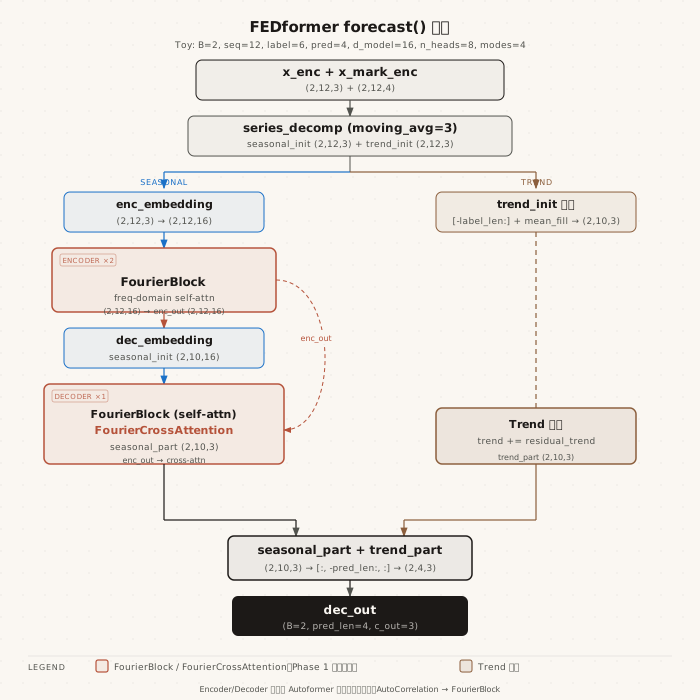
三、架构概览(论文层 mermaid)
整体架构 SVG:
四、TFB 调用链
五、BFS 文档树
| 文件 | 内容 | 下钻理由 |
|---|---|---|
| [[01-Layer0-接入界面]] | TransformerAdapter + FEDformer 三个专属参数 | 有独立 I/O、多步配置 |
| [[02-Layer1-forecast主链]] | series_decomp + 双路构造 + enc + dec | 主链 ≥8 步骤 |
| [[03A-Layer2A-FourierBlock]] | FFT → 复数线性变换 → irfft;⚠️ n_heads=8 硬编码 | ≥5步 + view quirk |
| [[03B-Layer2B-FourierCrossAttention]] | 频域 Q×K 注意力 + tanh + V 加权 | 4步 einsum + 不同 seq_len |
Series Decomp、EncoderLayer/DecoderLayer 骨架:与 Autoformer 代码完全相同,见 [[Autoformer]] 系列文档(
03D-Layer2D-SeriesDecomp、03B1-Layer3-EncoderLayer、03C1-Layer3-DecoderLayer)。FEDformer 的唯一区别是 attention 组件替换为 FourierBlock / FourierCrossAttention。
六、论文组件 → 代码对应表
| 论文组件 | TFB 代码实现 | 源文件 | 精读文档 |
|---|---|---|---|
| FEB-f(频域 Encoder 块) | FourierBlock | FourierCorrelation.py | [[03A-Layer2A-FourierBlock]] |
| FEB-fw(频域 Cross 块) | FourierCrossAttention | FourierCorrelation.py | [[03B-Layer2B-FourierCrossAttention]] |
| Series Decomp | series_decomp(同 Autoformer) | Autoformer_EncDec.py | [[Autoformer/03D-Layer2D-SeriesDecomp]] |
| MOEDecomp | ⚠️ 未实现,TFB 用 series_decomp 替代 | — | — |
| Encoder Layer | EncoderLayer(同 Autoformer) | Autoformer_EncDec.py | [[Autoformer/03B1-Layer3-EncoderLayer]] |
| Decoder Layer | DecoderLayer(同 Autoformer) | Autoformer_EncDec.py | [[Autoformer/03C1-Layer3-DecoderLayer]] |
七、全局 Toy 参数
| 参数 | 值 | 说明 |
|---|---|---|
| B | 3 | batch size |
| seq_len | 12 | encoder 输入长度 |
| label_len | 6 | decoder 历史前缀 |
| pred_len | 4 | 预测步数 |
| dec_len | 10 | = label_len + pred_len |
| enc_in = dec_in = c_out | 5 | 变量数 |
| d_model | 16 | 隐层维度(必须被 8 整除!) |
| n_heads | 8 | 必须 = 8(FourierBlock 硬编码,见 §8) |
| d_keys = E | 2 | = d_model / n_heads = 16 / 8 |
| d_ff | 32 | FFN 隐层 |
| modes | 4 | 频率注意力选用的模式数(用户设置),实际 = min(4, seq_len//2=6) = 4 |
| mode_select | random | 模式选择策略 |
| moving_avg | 7 | 分解核大小(奇数,覆盖 Autoformer 默认 25) |
| time_dims | 4 | 时间标记特征维度(embed="timeF") |
| e_layers | 2 | encoder 层数 |
| d_layers | 1 | decoder 层数 |
维度唯一性验证:B=3, seq_len=12, label_len=6, pred_len=4, dec_len=10, enc_in=5, d_model=16, n_heads=8, d_keys=2, modes=4(actual_modes 实际与 pred_len/time_dims 同为 4,但这三者始终出现在不同 tensor 维度上,追踪中不会混淆), d_ff=32, moving_avg=7。
八、关键 Quirks(运行前须知)
⚠️ FourierBlock 硬编码 n_heads=8
FourierBlock.__init__中weights1第一维写死为 8,不使用n_heads参数:pythonself.weights1 = nn.Parameter( self.scale * torch.rand(8, in_channels // 8, out_channels // 8, len(self.index), ...) )因此 n_heads 必须等于 8,否则
einsum("bhi,hio->bho")中 h 维不匹配,运行时报错。 TFB 默认n_heads=8满足此约束。FourierCrossAttention正确使用num_heads参数,无此问题。
AutoCorrelationLayer 的 shape 语义 quirk
AutoCorrelationLayer.forward()在调用inner_correlation(即 FourierBlock)后执行:pythonout = out.view(B, L, -1)FourierBlock 返回
(B, H, E, L) = (3, 8, 2, 12),但view(3, 12, -1)期望输入按(B, L, H*E)排列。实际上 total elements 相同(3×8×2×12 = 3×12×16),reshape 不报错,但每个"时间步"包含了来自不同 head 和不同时间位置的混合数据。模型仍能收敛(out_projection 是全连接层,可从混合表示学习映射),但这是已知的布局语义偏差。
九、推荐阅读路径
快速理解 FEDformer 设计意图:[[00-总览]] → §二核心创新 → [[03A-Layer2A-FourierBlock]] §宏观逻辑 → [[04-收束]] 对比表
完整代码精读:[[00-总览]] → [[01-Layer0-接入界面]] → [[02-Layer1-forecast主链]] → [[03A-Layer2A-FourierBlock]] → [[03B-Layer2B-FourierCrossAttention]] → [[04-收束]]
创建:2026-04-26 · 完整 BFS 精读文档(替换 2026-04-24 局部精读版)