Appearance
Layer 3 — EncoderLayer 精读
父层(Layer 2B)
Encoder.forward的循环体调用attn_layer(x, ...)。
本文档只覆盖EncoderLayer.forward这一层(Transformer block 结构)。
子层 AttentionLayer 及以下见 04-Layer4-AttentionLayer。
1. 在父层中的位置
Encoder.forward
  └─ for i, (attn_layer, conv_layer) in enumerate(zip(...)):
         x, attn = attn_layer(x, ...)   ← 本文档(EncoderLayer 0)
         x = conv_layer(x)
     x, attn = attn_layers[-1](x, ...)  ← 本文档(EncoderLayer 1)
          └─ self.attention(x, x, x, ...)   → 详见 Layer4 AttentionLayer
2. I/O 接口定义
python
def forward(self, x, attn_mask=None, tau=None, delta=None):| shape(toy,EncoderLayer 0) | 含义 | |
|---|---|---|
输入 x | (3, 10, 8) = (B, seq_len, d_model) | 当前层的 token 序列 |
输出 x | (3, 10, 8) | 经过注意力 + FFN 变换后,形状不变 |
输出 attn | None | output_attention=False 时为 None |
EncoderLayer 1 输入为
(3, 6, 8)(ConvLayer 压缩后),形状逻辑相同。
3. 顺序图(具体层)
4. 语义分组图(索引层)
两块结构完全对称:操作 → 残差 → LayerNorm(Post-norm 形式)。
与 PatchTST 的 EncoderLayer 结构相同,区别在于:Informer 用 ProbAttention,激活函数用 relu。
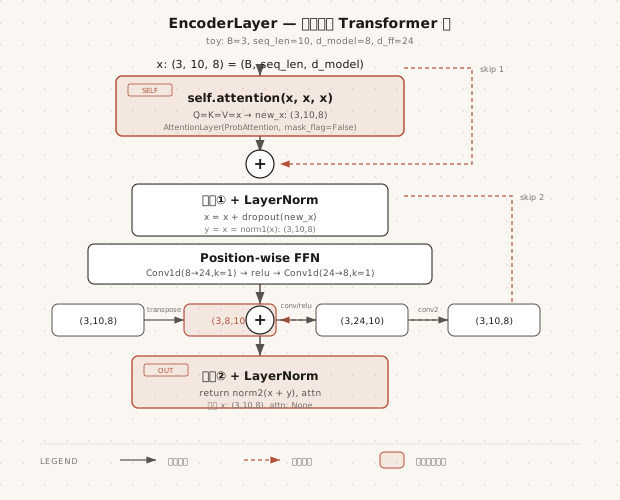
5. 逐步解析
5.0 完整原始代码
python
class EncoderLayer(nn.Module):
    def __init__(self, attention, d_model, d_ff=None, dropout=0.1, activation="relu"):
        super(EncoderLayer, self).__init__()
        d_ff = d_ff or 4 * d_model
        self.attention = attention
        self.conv1 = nn.Conv1d(in_channels=d_model, out_channels=d_ff, kernel_size=1)   # 升维
        self.conv2 = nn.Conv1d(in_channels=d_ff, out_channels=d_model, kernel_size=1)   # 降维
        self.norm1 = nn.LayerNorm(d_model)
        self.norm2 = nn.LayerNorm(d_model)
        self.dropout = nn.Dropout(dropout)
        self.activation = F.relu if activation == "relu" else F.gelu

def forward(self, x, attn_mask=None, tau=None, delta=None):
    new_x, attn = self.attention(x, x, x, attn_mask=attn_mask, tau=tau, delta=delta)
    x = x + self.dropout(new_x)

    y = x = self.norm1(x)
    y = self.dropout(self.activation(self.conv1(y.transpose(-1, 1))))
    y = self.dropout(self.conv2(y).transpose(-1, 1))

    return self.norm2(x + y), attn
5.1 注意力残差块(步骤一 + 步骤二)
本节的作用
ProbSparse 自注意力 + dropout 残差 + LayerNorm 构成第一个子块;
y = x = norm1(x)的双赋值为后续 FFN 残差做准备。
步骤一:调用 AttentionLayer(自注意力)
python
new_x, attn = self.attention(x, x, x, attn_mask=attn_mask, tau=tau, delta=delta)三个位置参数都传同一个 x,对应 queries, keys, values,即自注意力(Q=K=V=x)。attn_mask=None,透传给 ProbAttention(内部自行处理 causal mask)。
返回:new_x=(3,10,8) 是 ProbSparse 注意力加权的新表示;attn=None。
→ AttentionLayer 的内部细节见 04-Layer4-AttentionLayer。
步骤二:残差① + norm1
python
x = x + self.dropout(new_x)

y = x = self.norm1(x)
x + dropout(new_x):残差跳接,dropout 在加之前施加作正则化。
y = x = self.norm1(x) 一行两赋值:LayerNorm 后 x 和 y 同时指向这个结果。后续 FFN 修改 y,最终 x+y 做残差②。
x_old: (3,10,8)
new_x: (3,10,8)  ← ProbAttention 输出
x = x_old + dropout(new_x): (3,10,8)
x = y = norm1(x): (3,10,8)
5.2 FFN 残差块(步骤三 + 步骤四 + 步骤五)
本节的作用
Position-wise FFN:Conv1d(k=1) 实现的逐位置
Linear(8→24) → relu → Linear(24→8)+ dropout 残差 + LayerNorm 构成第二个子块。
Position-wise FFN:对序列中每个位置独立做 Linear(8→24) → relu → Linear(24→8),用 Conv1d(k=1) 实现。
步骤三:FFN 第一层(升维 + 激活)
python
y = self.dropout(self.activation(self.conv1(y.transpose(-1, 1))))y.transpose(-1, 1): (3, 10, 8) → (3, 8, 10) Conv1d 需要 (B, C, L) 格式
conv1: Conv1d(8, 24, k=1): (3, 8, 10) → (3, 24, 10)
relu(...):逐元素激活(Informer 默认 relu,PatchTST 是 gelu)
dropout: (3, 24, 10)步骤四:FFN 第二层(降维)
python
y = self.dropout(self.conv2(y).transpose(-1, 1))conv2: Conv1d(24, 8, k=1): (3, 24, 10) → (3, 8, 10)
transpose(-1, 1): (3, 8, 10) → (3, 10, 8)
dropout: (3, 10, 8)步骤五:残差② + norm2
python
return self.norm2(x + y), attnx: (3,10,8) ← norm1 输出(步骤二赋值,未被 FFN 修改)
y: (3,10,8) ← FFN 输出
norm2(x + y): (3,10,8)6. 下钻子组件
| 子组件 | 职责 | 下层文档 |
|---|---|---|
AttentionLayer(self.attention) | d_model 格式 ↔ 多头格式桥梁;Q/K/V 投影 + 委托 ProbAttention | 04-Layer4-AttentionLayer |