Appearance
Layer 2B — Encoder(Distilling 调度层)
父层(Layer 1)的步骤④:
self.encoder(enc_out, attn_mask=None)。
本文档只覆盖Encoder.forward这一层(distilling 分支路由 + 循环调度 + 最终 LayerNorm)。
子层 EncoderLayer 及以下见 03B1-Layer3-EncoderLayer。
1. 在父层中的位置
long_forecast()
  └─ ④ enc_out, attns = self.encoder(enc_out, attn_mask=None)   ← 本文档
          ├─ EncoderLayer 0 + ConvLayer 0   (seq: 10 → 6)       → 详见 Layer3
          └─ EncoderLayer 1(最后一层)      (seq: 6 → 6)        → 详见 Layer3
2. I/O 接口定义
python
def forward(self, x, attn_mask=None, tau=None, delta=None):| shape(toy) | 含义 | |
|---|---|---|
输入 x | (3, 10, 8) = (B, seq_len, d_model) | encoder embedding 输出 |
输出 x | (3, 6, 8) | distilling 后的 encoder 表示(seq 10→6) |
输出 attns | [None, None] | 注意力权重列表(output_attention=False) |
attn_mask / tau / delta全为None,原样透传给 EncoderLayer。
3. 顺序图(具体层)
4. 语义分组图(索引层)
Encoder 只做"管理":选路径 → 按轮次调度 EncoderLayer + ConvLayer → 收尾归一化。
5. 逐步解析
5.0 完整原始代码
python
class Encoder(nn.Module):
    def __init__(self, attn_layers, conv_layers=None, norm_layer=None):
        super(Encoder, self).__init__()
        self.attn_layers = nn.ModuleList(attn_layers)
        self.conv_layers = (
            nn.ModuleList(conv_layers) if conv_layers is not None else None
        )
        self.norm = norm_layer

	def forward(self, x, attn_mask=None, tau=None, delta=None):
	    # x [B, L, D]
	    attns = []
	    if self.conv_layers is not None:
	        for i, (attn_layer, conv_layer) in enumerate(
	            zip(self.attn_layers, self.conv_layers)
	        ):
	            delta = delta if i == 0 else None
	            x, attn = attn_layer(x, attn_mask=attn_mask, tau=tau, delta=delta)
	            x = conv_layer(x)
	            attns.append(attn)
	        x, attn = self.attn_layers[-1](x, tau=tau, delta=None)
	        attns.append(attn)
	    else:
	        for attn_layer in self.attn_layers:
	            x, attn = attn_layer(x, attn_mask=attn_mask, tau=tau, delta=delta)
	            attns.append(attn)

	    if self.norm is not None:
	        x = self.norm(x)
	    return x, attns
5.1 分支路由(if/else)
本节的作用
根据
conv_layers是否为None决定走 distilling 路径(Informer)还是简单串联路径(PatchTST 等)。
| 分支 | 条件 | 迭代逻辑 | 适用模型 |
|---|---|---|---|
if(distilling) | conv_layers is not None ← Informer | attn_layer + conv_layer 交替;最后再单独跑 attn_layers[-1] | Informer |
else(简单串联) | conv_layers is None | 只有 attn_layer,纯串联 | PatchTST / 通用 Transformer |
Informer 构造时传入 conv_layers=[ConvLayer_0](e_layers-1=1 个),走 if 分支。
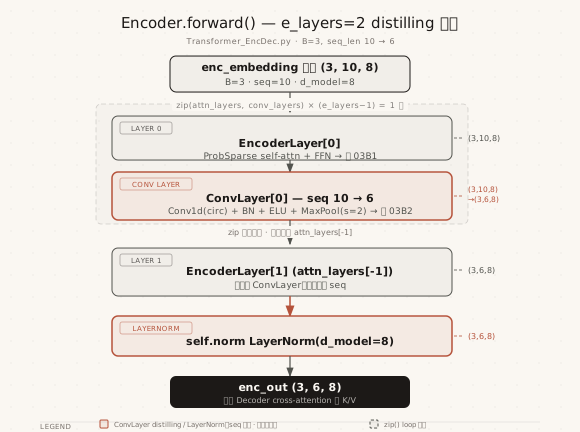
5.2 distilling 循环调度
本节的作用
zip(attn_layers, conv_layers)将 EncoderLayer 和 ConvLayer 配对循环,实现交替"注意力 → 压缩";最后单独调用attn_layers[-1]补上最后一个 EncoderLayer。
python
for i, (attn_layer, conv_layer) in enumerate(
    zip(self.attn_layers, self.conv_layers)
):
    delta = delta if i == 0 else None
    x, attn = attn_layer(x, attn_mask=attn_mask, tau=tau, delta=delta)
    x = conv_layer(x)
    attns.append(attn)
x, attn = self.attn_layers[-1](x, tau=tau, delta=None)
attns.append(attn)
zip(self.attn_layers, self.conv_layers) 把 e_layers-1=1 组 (EncoderLayer, ConvLayer) 配对循环。每轮:EncoderLayer 做注意力(形状不变),ConvLayer 做 seq 压缩。
循环结束后,单独调用 attn_layers[-1](最后一个 EncoderLayer,不再配 ConvLayer)。
delta 只在 i==0 时传真实值,后续置 None——因为 delta 是对第一层 Encoder 的外部偏移信号。
x: (3,10,8) → EncoderLayer 0 → (3,10,8) → ConvLayer 0 → (3,6,8)
                                                           ↑
                                                     seq 10→6(distilling)
(3,6,8) → EncoderLayer 1(attn_layers[-1])→ (3,6,8)

attns = [None, None]
EncoderLayer 的内部细节见 03B1-Layer3-EncoderLayer。
ConvLayer 的 seq 压缩逻辑见下方 §5 ConvLayer 一节。
5.3 ConvLayer — seq 压缩(distilling 核心)
Transformer_EncDec.py:6(__init__)/ Transformer_EncDec.py:20(forward)
Conv1d(k=3, circular) → BatchNorm → ELU → MaxPool(stride=2) 把 seq 从 10 压到 6:
(3,10,8) → permute → (3,8,10) → Conv1d → (3,8,12) → BN+ELU → MaxPool → (3,8,6) → transpose → (3,6,8)完整逐步精读(含 toy 数值、circular padding 推导、MaxPool 窗口计算)→ [[03B2-Layer3-ConvLayer]]
5.4 最终归一化
本节的作用
所有 EncoderLayer 和 ConvLayer 执行完毕后,对最终 token 序列做一次 LayerNorm,统一数值范围再返回给父层。
python
if self.norm is not None:
    x = self.norm(x)
return x, attns
self.norm = LayerNorm(8),对最后一维归一化,形状不变 (3,6,8)。
6. 下钻子组件
| 子组件 | 职责 | 下层文档 |
|---|---|---|
EncoderLayer(attn_layer) | Transformer block:ProbSparse 注意力残差 + FFN 残差 | [[03B1-Layer3-EncoderLayer]] |
ConvLayer(conv_layer) | Conv1d + BN + ELU + MaxPool(stride=2),seq 压缩(distilling 核心) | [[03B2-Layer3-ConvLayer]] |