Appearance
Conv1d 与 BCL 格式:Informer、PatchTST 的卷积和 FFN
Abstract
这篇只讲一个关键习惯:
nn.Conv1d的输入格式是(B, C, L),不是时间序列模型里常见的(B, L, C)。
0. 文件索引
| 项目 | 内容 |
|---|---|
| 覆盖函数 | nn.Conv1d |
| 覆盖源码 | Embed.py / Transformer_EncDec.py |
| 覆盖模型 | Informer / PatchTST |
| 核心格式 | (B, C, L) |
| 常见配套操作 | permute(0, 2, 1) / transpose(-1, 1) |
1. Level 1:Conv1d 的输入格式
nn.Conv1d 期望输入:
text
(N, C_in, L)在本文时序语境里:
| 维度 | 含义 |
|---|---|
N | batch size |
C_in | channel / feature / d_model |
L | 序列长度 |
但是模型主线里经常是:
text
(B, L, C)所以进入 Conv1d 前经常要换维。
2. Level 2:Informer 的 TokenEmbedding
源码:
python
class TokenEmbedding(nn.Module):
    def __init__(self, c_in, d_model):
        super(TokenEmbedding, self).__init__()
        padding = 1 if torch.__version__ >= "1.5.0" else 2
        self.tokenConv = nn.Conv1d(
            in_channels=c_in,
            out_channels=d_model,
            kernel_size=3,
            padding=padding,
            padding_mode="circular",
            bias=False,
        )

    def forward(self, x):
        x = self.tokenConv(x.permute(0, 2, 1)).transpose(1, 2)
        return x
toy:
text
x.shape = (B, L, C) = (2, 6, 3)
d_model = 16
逐步:
text
x.permute(0, 2, 1):
  (2, 6, 3) -> (2, 3, 6)

tokenConv Conv1d(3 -> 16, kernel=3):
  (2, 3, 6) -> (2, 16, 6)

transpose(1, 2):
  (2, 16, 6) -> (2, 6, 16)
语义:
每个时间步附近的局部窗口被卷积聚合,原始
C=3个变量被投影成d_model=16维表示。
3. Level 3:Informer ConvLayer 的 distilling
源码:
python
class ConvLayer(nn.Module):
    def __init__(self, c_in):
        super(ConvLayer, self).__init__()
        self.downConv = nn.Conv1d(
            in_channels=c_in,
            out_channels=c_in,
            kernel_size=3,
            padding=2,
            padding_mode="circular",
        )
        self.norm = nn.BatchNorm1d(c_in)
        self.activation = nn.ELU()
        self.maxPool = nn.MaxPool1d(kernel_size=3, stride=2, padding=1)

    def forward(self, x):
        x = self.downConv(x.permute(0, 2, 1))
        x = self.norm(x)
        x = self.activation(x)
        x = self.maxPool(x)
        x = x.transpose(1, 2)
        return x
toy:
text
x: (B, L, d_model) = (2, 6, 16)逐步:
text
permute:
  (2, 6, 16) -> (2, 16, 6)

Conv1d(16 -> 16, kernel=3):
  (2, 16, 6) -> (2, 16, 8)  # circular padding=2 时长度可能先变长

BatchNorm1d + ELU:
  (2, 16, 8) -> (2, 16, 8)

MaxPool1d(kernel=3, stride=2, padding=1):
  (2, 16, 8) -> (2, 16, 4)

transpose:
  (2, 16, 4) -> (2, 4, 16)
这个模块的语义是:
在 encoder 层之间压缩序列长度,也就是 Informer 论文里的 distilling。
4. Level 4:EncoderLayer 里的 Conv1d(kernel_size=1)
源码:
python
class EncoderLayer(nn.Module):
    def __init__(self, attention, d_model, d_ff=None, dropout=0.1, activation="relu"):
        super(EncoderLayer, self).__init__()
        d_ff = d_ff or 4 * d_model
        self.attention = attention
        self.conv1 = nn.Conv1d(in_channels=d_model, out_channels=d_ff, kernel_size=1)
        self.conv2 = nn.Conv1d(in_channels=d_ff, out_channels=d_model, kernel_size=1)
        self.norm1 = nn.LayerNorm(d_model)
        self.norm2 = nn.LayerNorm(d_model)
        self.dropout = nn.Dropout(dropout)
        self.activation = F.relu if activation == "relu" else F.gelu

    def forward(self, x, attn_mask=None, tau=None, delta=None):
        new_x, attn = self.attention(x, x, x, attn_mask=attn_mask, tau=tau, delta=delta)
        x = x + self.dropout(new_x)

        y = x = self.norm1(x)
        y = self.dropout(self.activation(self.conv1(y.transpose(-1, 1))))
        y = self.dropout(self.conv2(y).transpose(-1, 1))

        return self.norm2(x + y), attn
在 PatchTST 的 EncoderLayer 里,这里的 Conv1d(kernel_size=1) 位于 attention 之后的 FFN 分支。下图按本文 toy 例子重画:重点不是完整 EncoderLayer,而是 BLC -> BCL -> Conv1d(kernel=1) -> BLC 这条格式链。
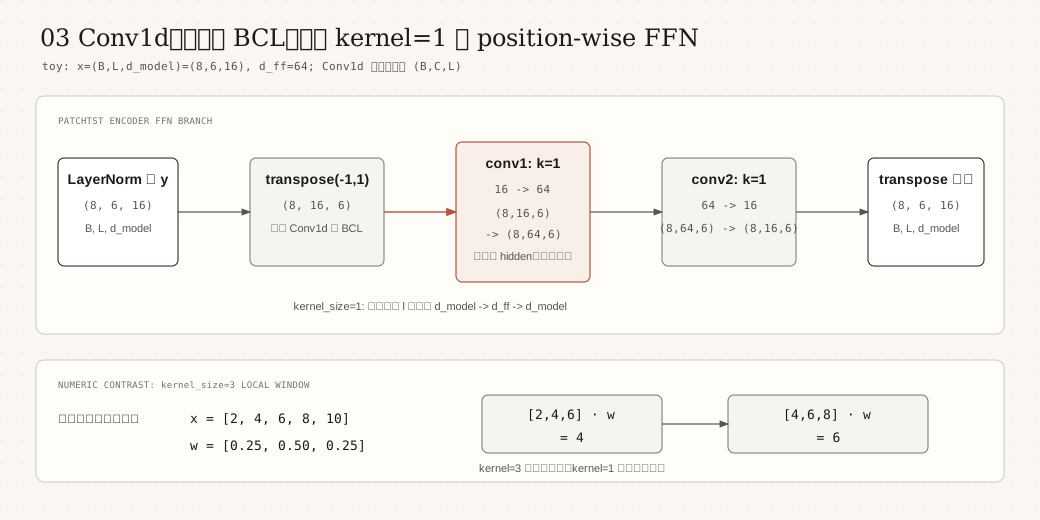
toy:
text
x = (B, L, d_model) = (8, 6, 16)
d_ff = 64
FFN 部分:
text
y.transpose(-1, 1):
  (8, 6, 16) -> (8, 16, 6)

conv1 Conv1d(16 -> 64, kernel=1):
  (8, 16, 6) -> (8, 64, 6)

conv2 Conv1d(64 -> 16, kernel=1):
  (8, 64, 6) -> (8, 16, 6)

transpose(-1, 1):
  (8, 16, 6) -> (8, 6, 16)
5. Level 5:为什么 kernel_size=1 等价于 position-wise FFN
kernel_size=1 的卷积每次只看当前位置,不看左右邻居。
所以对每个时间位置 l:
text
y[:, :, l] = W * x[:, :, l] + b它只混合 channel / hidden 维,不混合时间维。
这和 Transformer 原论文里的 position-wise feed-forward network 是同一件事:
text
每个位置独立做:
d_model -> d_ff -> d_model
6. 可算小例子
假设 Conv1d(in_channels=1, out_channels=1, kernel_size=3, bias=False),权重:
text
w = [0.25, 0.50, 0.25]输入单通道序列:
text
x = [2, 4, 6, 8, 10]不考虑 padding 时,第一个输出窗口:
text
[2, 4, 6] -> 2*0.25 + 4*0.50 + 6*0.25 = 4第二个输出窗口:
text
[4, 6, 8] -> 4*0.25 + 6*0.50 + 8*0.25 = 6所以卷积可以理解成:
用一个可学习的局部窗口,在时间轴上滑动提取局部模式。
7. 常见错误
7.1 把 (B, L, C) 直接送进 Conv1d
错误:
python
self.conv(x) # x: (B, L, C)Conv1d 会把 L 当成 channel,把 C 当成序列长度。
正确:
python
self.conv(x.permute(0, 2, 1))7.2 混淆 Conv1d(kernel=3) 和 Conv1d(kernel=1)
| 写法 | 是否混合时间邻居 | 常见用途 |
|---|---|---|
Conv1d(kernel_size=3) | yes | 局部时间模式、distill |
Conv1d(kernel_size=1) | no | position-wise FFN |
8. 一句话总结
Conv1d 的核心理解是:
输入必须是
(B,C,L);kernel_size=3看局部时间窗口,kernel_size=1只对每个位置做通道维投影。