Appearance
Layer 1 — forecast() 主链
1. 在父层中的位置
FEDformer.forward() 判断 task_name == "short_term_forecast" 后调用 self.forecast(),这是整个预测的主干。
2. I/O 接口定义
| 参数 | Shape | 含义 |
|---|---|---|
x_enc | (3, 12, 5) | encoder 输入(原始时序) |
x_mark_enc | (3, 12, 4) | encoder 时间标记 |
x_dec | (3, 10, 5) | decoder 输入(⚠️ 内容被忽略,只决定形状隐式约束) |
x_mark_dec | (3, 10, 4) | decoder 时间标记 |
输出:dec_out shape (3, 10, 5),由 forward() 截取 [:, -4:, :] → (3, 4, 5)
3. 顺序图
4. 语义分组图
5. 逐步骤精读
§5.0 完整原始代码
python
class FEDformer(nn.Module):
    def __init__(self, configs, version="fourier", mode_select="random", modes=32):
        super(FEDformer, self).__init__()
        self.task_name = configs.task_name
        self.seq_len = configs.seq_len
        self.label_len = configs.label_len
        self.pred_len = configs.pred_len
        self.version = version
        self.mode_select = mode_select
        self.modes = modes

        self.decomp = series_decomp(configs.moving_avg)
        self.enc_embedding = DataEmbedding(
            configs.enc_in, configs.d_model, configs.embed, configs.freq, configs.dropout,
        )
        self.dec_embedding = DataEmbedding(
            configs.dec_in, configs.d_model, configs.embed, configs.freq, configs.dropout,
        )

        if self.version == "Wavelets":
            ...  # Wavelets 分支(TFB 不走这里)
        else:
            encoder_self_att = FourierBlock(
                in_channels=configs.d_model, out_channels=configs.d_model,
                seq_len=self.seq_len, modes=self.modes,
                mode_select_method=self.mode_select,
            )
            decoder_self_att = FourierBlock(
                in_channels=configs.d_model, out_channels=configs.d_model,
                seq_len=self.seq_len // 2 + self.pred_len,
                modes=self.modes, mode_select_method=self.mode_select,
            )
            decoder_cross_att = FourierCrossAttention(
                in_channels=configs.d_model, out_channels=configs.d_model,
                seq_len_q=self.seq_len // 2 + self.pred_len,
                seq_len_kv=self.seq_len,
                modes=self.modes, mode_select_method=self.mode_select,
                num_heads=configs.n_heads,
            )
        self.encoder = Encoder(
            [EncoderLayer(
                AutoCorrelationLayer(encoder_self_att, configs.d_model, configs.n_heads),
                configs.d_model, configs.d_ff,
                moving_avg=configs.moving_avg, dropout=configs.dropout,
                activation=configs.activation,
            ) for l in range(configs.e_layers)],
            norm_layer=my_Layernorm(configs.d_model),
        )
        self.decoder = Decoder(
            [DecoderLayer(
                AutoCorrelationLayer(decoder_self_att, configs.d_model, configs.n_heads),
                AutoCorrelationLayer(decoder_cross_att, configs.d_model, configs.n_heads),
                configs.d_model, configs.c_out, configs.d_ff,
                moving_avg=configs.moving_avg, dropout=configs.dropout,
                activation=configs.activation,
            ) for l in range(configs.d_layers)],
            norm_layer=my_Layernorm(configs.d_model),
            projection=nn.Linear(configs.d_model, configs.c_out, bias=True),
        )

    def forecast(self, x_enc, x_mark_enc, x_dec, x_mark_dec):
        # decomp init
        mean = torch.mean(x_enc, dim=1).unsqueeze(1).repeat(1, self.pred_len, 1)
        seasonal_init, trend_init = self.decomp(x_enc)
        # decoder input
        trend_init = torch.cat([trend_init[:, -self.label_len:, :], mean], dim=1)
        seasonal_init = F.pad(
            seasonal_init[:, -self.label_len:, :], (0, 0, 0, self.pred_len)
        )
        # enc
        enc_out = self.enc_embedding(x_enc, x_mark_enc)
        dec_out = self.dec_embedding(seasonal_init, x_mark_dec)
        enc_out, attns = self.encoder(enc_out, attn_mask=None)
        # dec
        seasonal_part, trend_part = self.decoder(
            dec_out, enc_out, x_mask=None, cross_mask=None, trend=trend_init
        )
        # final
        dec_out = trend_part + seasonal_part
        return dec_out
§5.1 宏观逻辑
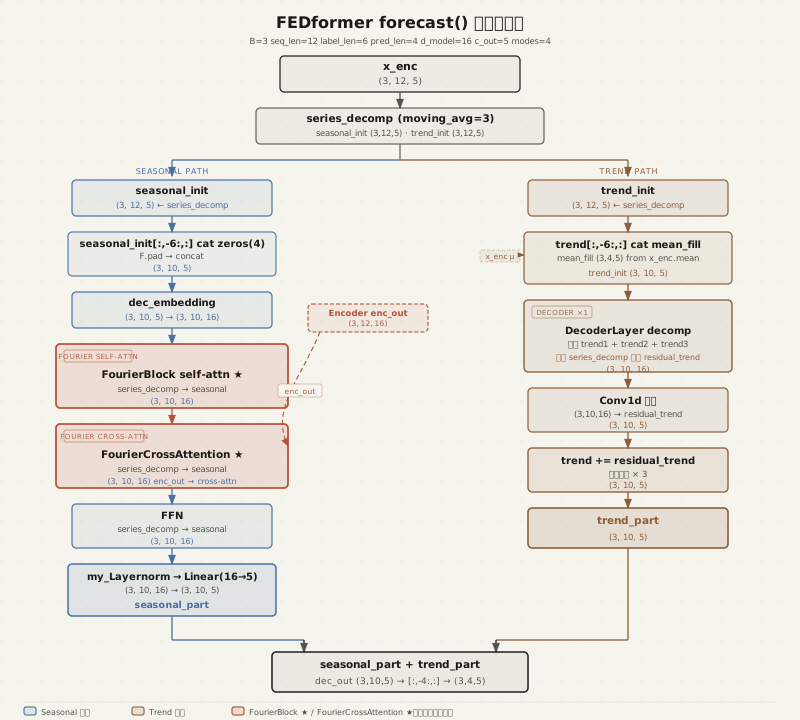
核心设计意图:FEDformer 继承 Autoformer 的"进式分解"(Progressive Decomposition)思想:维护 seasonal 和 trend 两条独立路径,但把 Encoder 和 Decoder 中的 Auto-Correlation 全部换成频域注意力。
双路结构:
- Seasonal 路径(蓝色):贯穿 Encoder 和 Decoder,每次分解都保留 seasonal,由 my_Layernorm + Linear(d_model→c_out) 最终投影
- Trend 路径(橙色):从
trend_init出发,DecoderLayer 的 3 次分解分别抽出 trend1/2/3,累加后由 Conv1d 投影为residual_trend,最终trend_part = trend_init + Σresidual_trend
用小例子(B=1, seq_len=4, label_len=2, pred_len=2, enc_in=2, d_model=4, n_heads=8)串起来:
x_enc = [[1,2],[3,4],[2,5],[4,3]]  shape (1,4,2)

mean = x_enc.mean(dim=1) = [[2.5, 3.5]] → unsqueeze → (1,1,2) → repeat(1,2,1) → (1,2,2)

series_decomp(x_enc):
  seasonal_init = x_enc - moving_avg → (1,4,2)
  trend_init = moving_avg(x_enc) → (1,4,2)

trend_init = cat[trend_init[:,-2:,:], mean] = cat[(1,2,2),(1,2,2)] = (1,4,2)
seasonal_init = F.pad(seasonal_init[:,-2:,:], (0,0,0,2))
             = cat[(1,2,2), zeros(1,2,2)] = (1,4,2)
完整 shape 变化链:
(3,12,5) → [series_decomp] → (3,12,5)×2 → [构造 dec_init] → (3,10,5)×2 → [enc_embedding→Encoder] → enc_out(3,12,16) → [dec_embedding→Decoder] → seasonal_part(3,10,5) + trend_part(3,10,5) → [sum] → (3,10,5) → [forward截取[:,-4:,:]] → (3,4,5)
整体数据流 SVG:
§5.2 步骤 ① — mean 计算(trend 占位填充值)
python
mean = torch.mean(x_enc, dim=1).unsqueeze(1).repeat(1, self.pred_len, 1)x_enc.mean(dim=1) 在时间轴(seq_len=12)取均值,shape (3, 5)。
.unsqueeze(1) → (3, 1, 5)。
.repeat(1, 4, 1) → (3, 4, 5) — 4 = pred_len。
作用:用历史均值填充 trend_init 的"未来"占位段,比用零初始化更接近历史水平,帮助 Decoder 从合理的趋势基准出发。
toy 值:若 x_enc[0,:,0] = [1,3,5,7,9,11,8,6,4,2,4,6],mean[0,0,0] = sum/12 ≈ 5.5,则 mean[0,:,0] = [5.5, 5.5, 5.5, 5.5](pred_len 个重复值)。
§5.3 步骤 ② — series_decomp 分解
python
seasonal_init, trend_init = self.decomp(x_enc)series_decomp(moving_avg=7) 内部:
moving_avg(x_enc, kernel=7)— replicate padding 各 3 步((7-1)//2=3),AvgPool1d,再 permute 还原 → trend_init shape (3, 12, 5)seasonal_init = x_enc - trend_init→ shape (3, 12, 5)
toy 值:x_enc[0,0,0]=1.0,经 7 步平均(边缘 replicate padding 后),trend_init[0,0,0] ≈ 2.1(前 3 步 padding 的影响),seasonal_init[0,0,0] ≈ 1.0 - 2.1 = -1.1。
§5.4 步骤 ③④ — 构造 Decoder 初始化输入
Trend 初始化:
python
trend_init = torch.cat([trend_init[:, -self.label_len:, :], mean], dim=1)trend_init[:, -6:, :] → (3, 6, 5)(真实历史 trend 末段)。
cat([(3,6,5), mean(3,4,5)], dim=1) → trend_init shape (3, 10, 5)。
语义:前 6 步 = 历史趋势(来自 series_decomp),后 4 步 = 均值占位(模型学习如何从此基准预测未来趋势)。
Seasonal 初始化:
python
seasonal_init = F.pad(
    seasonal_init[:, -self.label_len:, :], (0, 0, 0, self.pred_len)
)
seasonal_init[:, -6:, :] → (3, 6, 5)。
F.pad(..., (0, 0, 0, 4)) 对 3D 张量:最后 2 个 pad 值 (0, 4) 作用在 dim=1(时间轴)末端追加 4 步零 → (3, 10, 5)。
语义:前 6 步 = 历史 seasonal 成分(label 段),后 4 步 = 全零(Decoder 学习预测未来 seasonal 波动)。
toy 值:seasonal_init[0,-1,0]=0.8(最后一个历史 seasonal 值),填充后 seasonal_init[0,6:,0] = [0,0,0,0]。
§5.5 步骤 ⑤⑥ — Encoder
python
enc_out = self.enc_embedding(x_enc, x_mark_enc)
enc_out, attns = self.encoder(enc_out, attn_mask=None)enc_embedding(DataEmbedding):x_enc (3,12,5) + x_mark_enc (3,12,4) → enc_out (3, 12, 16)。包含 TokenEmbedding(Conv1d)+ TemporalEmbedding + PositionalEmbedding。
encoder:e_layers=2 个 EncoderLayer,每层:
- AutoCorrelationLayer(FourierBlock) → series_decomp → seasonal residual(丢弃 trend)
- FFN(Conv1d 1×1)→ series_decomp → seasonal residual(丢弃 trend)
输入 (3,12,16) → 2 次 EncoderLayer → my_Layernorm → enc_out (3, 12, 16)(形状不变,无 distilling)。
§5.6 步骤 ⑦⑧ — Decoder
python
dec_out = self.dec_embedding(seasonal_init, x_mark_dec)
seasonal_part, trend_part = self.decoder(
    dec_out, enc_out, x_mask=None, cross_mask=None, trend=trend_init
)dec_embedding:seasonal_init (3,10,5) + x_mark_dec (3,10,4) → dec_out (3, 10, 16)。
decoder(d_layers=1 个 DecoderLayer):
- self-attention:AutoCorrelationLayer(FourierBlock)(decoder 端 seq_len = dec_len=10)
- cross-attention:AutoCorrelationLayer(FourierCrossAttention)(Q from dec dec_len=10, K/V from enc seq_len=12)
- 3 次 series_decomp 各抽出 trend1/2/3
- residual_trend = trend1+trend2+trend3(经 Conv1d 投影回 enc_in=5)
- 循环积累:
trend = trend + residual_trend,最终 trend_part (3, 10, 5) - seasonal 穿透 → my_Layernorm → projection Linear(16→5) → seasonal_part (3, 10, 5)
FEDformer Decoder 与 Autoformer Decoder 的唯一区别
Autoformer Decoder 使用
AutoCorrelation作为 inner_correlation;FEDformer 使用FourierBlock(self-attn)和FourierCrossAttention(cross-attn)。EncoderLayer、DecoderLayer、series_decomp、my_Layernorm 代码完全共享。
§5.7 步骤 ⑨ — 合并
python
dec_out = trend_part + seasonal_part
return dec_out
trend_part (3, 10, 5) + seasonal_part (3, 10, 5) → dec_out (3, 10, 5)。
forward() 截取 [:, -4:, :] → (3, 4, 5) 返回。
toy 值(最后时间步 t₉):seasonal_part[0,9,0] = 0.3(季节性波动),trend_part[0,9,0] = 5.8(趋势基准),dec_out[0,9,0] = 6.1(预测值)。
6. 下钻子组件
| 子组件 | 职责 | 文档 |
|---|---|---|
FourierBlock | Encoder self-attn + Decoder self-attn:FFT→M频率线性变换→irfft | [[03A-Layer2A-FourierBlock]] |
FourierCrossAttention | Decoder cross-attn:频域 Q×K 注意力 | [[03B-Layer2B-FourierCrossAttention]] |
series_decomp / EncoderLayer / DecoderLayer | Autoformer 共享骨架 | [[Autoformer]] 文档 |