Appearance
Layer 3 — EncoderLayer 精读
由
Encoder.forward()循环调用 2 次([[03B-Layer2B-Encoder]])。
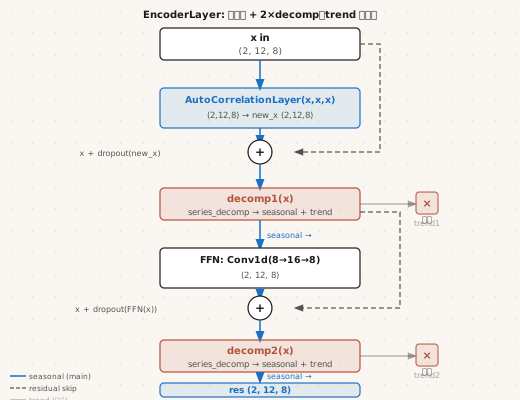
本层覆盖:AutoCorrelation self-attention + 残差 + decomp1 + FFN + 残差 + decomp2。
1. 在父层中的位置
Encoder.forward()
  └─ for attn_layer in self.attn_layers:
       x, attn = attn_layer(x)   ← EncoderLayer(本文档)
            └─ self.attention(x, x, x)  → 详见 04-Layer4-AutoCorrelationLayer
2. I/O 接口定义
| shape | 含义 | |
|---|---|---|
输入 x | (2, 12, 8) | 当前层的 seasonal 表示 |
输出 res | (2, 12, 8) | 经 AutoCorrelation + 2×decomp 精炼后的 seasonal 表示 |
输出 attn | None | output_attention=False 时为 None |
3. 顺序图(具体层)
4. 语义分组图(索引层)
Encoder 的每次 decomp 只保留 seasonal,trend 直接丢弃——这与 Decoder 形成对比(Decoder 累加所有 trend)。
5. 逐步精读
5.0 完整原始代码
python
class EncoderLayer(nn.Module):
    def __init__(
        self,
        attention,
        d_model,
        d_ff=None,
        moving_avg=25,
        dropout=0.1,
        activation="relu",
    ):
        super(EncoderLayer, self).__init__()
        d_ff = d_ff or 4 * d_model
        self.attention = attention
        self.conv1 = nn.Conv1d(
            in_channels=d_model, out_channels=d_ff, kernel_size=1, bias=False
        )
        self.conv2 = nn.Conv1d(
            in_channels=d_ff, out_channels=d_model, kernel_size=1, bias=False
        )
        self.decomp1 = series_decomp(moving_avg)
        self.decomp2 = series_decomp(moving_avg)
        self.dropout = nn.Dropout(dropout)
        self.activation = F.relu if activation == "relu" else F.gelu

    def forward(self, x, attn_mask=None):
        new_x, attn = self.attention(x, x, x, attn_mask=attn_mask)
        x = x + self.dropout(new_x)
        x, _ = self.decomp1(x)
        y = x
        y = self.dropout(self.activation(self.conv1(y.transpose(-1, 1))))
        y = self.dropout(self.conv2(y).transpose(-1, 1))
        res, _ = self.decomp2(x + y)
        return res, attn
5.1 残差块 1:AutoCorrelation + decomp1
步骤一:AutoCorrelation 注意力
python
new_x, attn = self.attention(x, x, x, attn_mask=attn_mask)
x = x + self.dropout(new_x)
self.attention 是 AutoCorrelationLayer,接收 Q=K=V=x(自注意力),返回 new_x (2,12,8)。残差相加后 x (2,12,8) 包含了注意力聚合的信息。
→ AutoCorrelationLayer 内部详见 [[04-Layer4-AutoCorrelationLayer]]
步骤二:decomp1 分解
python
x, _ = self.decomp1(x)decomp1(x) 返回 (seasonal, trend1),_ 接收并丢弃 trend1 (2,12,8),x 保留季节分量 (2,12,8)。
为什么 Encoder 丢弃 trend?
Encoder 的职责是提取输入序列的周期性模式,供 Decoder cross-attention 使用。趋势分量是低频的长期走势,在时延聚合(AutoCorrelation)中贡献的 lag 信息有限。丢弃 trend 使 Encoder 专注于季节性特征,从而在 cross-attention 中向 Decoder 传递更纯粹的周期信号。
Decoder 则需要同时维护趋势(因为最终预测需要 trend + seasonal),所以 DecoderLayer 的 3 次 decomp 都保留 trend 并累加。
5.2 残差块 2:FFN + decomp2
步骤三:Conv1d FFN
python
y = x
y = self.dropout(self.activation(self.conv1(y.transpose(-1, 1))))
y = self.dropout(self.conv2(y).transpose(-1, 1))
conv1 = nn.Conv1d(in_channels=8, out_channels=16, kernel_size=1)conv2 = nn.Conv1d(in_channels=16, out_channels=8, kernel_size=1)
Conv1d 要求 (B, C, L),而 y 是 (2, 12, 8):
y.transpose(-1, 1):      (2, 12, 8) → (2, 8, 12)
conv1:                   (2, 8, 12) → (2, 16, 12)
activation + dropout:    (2, 16, 12)
conv2:                   (2, 16, 12) → (2, 8, 12)
.transpose(-1, 1):       (2, 8, 12) → (2, 12, 8)
kernel_size=1 的 Conv1d 等价于 Position-wise Linear(每个时间步独立处理),与 Transformer FFN 语义相同,只是用 Conv1d 表达以利用批量计算优化。
toy 数值(batch=0, t=0):y[0,0,:] = [a0,...,a7](8维)→ conv1 升维到 16 → activation(gelu/relu)→ conv2 降维回 8 → y[0,0,:] = [b0,...,b7]。
步骤四:decomp2
python
res, _ = self.decomp2(x + y)x + y 是残差连接后的结果 (2, 12, 8);decomp2 再次分解,_ 丢弃 trend2,res 保留 seasonal。
最终 res (2, 12, 8) 是本层输出:经过 AutoCorrelation 聚合 + 两次趋势剥离后的纯 seasonal 表示。
6. 下钻子组件
| 子组件 | 职责 | 下层文档 |
|---|---|---|
AutoCorrelationLayer | Linear Q/K/V + view 多头 + FFT 互相关 | [[04-Layer4-AutoCorrelationLayer]] |
series_decomp(decomp1, decomp2) | moving_avg → trend;x − trend → seasonal | [[03D-Layer2D-SeriesDecomp]] |